
Learning Your Motorcycles Normal Sounds
Learn how understanding your motorcycles normal sounds helps you become a more confident and observant owner.
Ask a rider who has owned the same motorcycle for several years whether they could recognise it starting in a crowded parking area. Many would smile before answering yes. Not because the motorcycle is louder than every other machine around it, but because they have unconsciously learned its voice.
That familiarity rarely develops through deliberate effort. It grows naturally over thousands of kilometres, hundreds of starts, countless commutes and weekend rides. Long before riders begin thinking about maintenance, they begin recognising what feels and sounds normal.
Ironically, this quiet familiarity is one of the most valuable maintenance tools any rider can develop.
You do not need to become a mechanic to notice when something has changed. You simply need to know your motorcycle well enough to recognise when it no longer sounds like itself.
Rather than teaching repairs, this article is about building that relationship.
Every Motorcycle Has Its Own Voice
Two motorcycles of the same make and model can sound surprisingly different. A slightly different exhaust note, a familiar mechanical whirr, the gentle click of a fuel pump priming before startup or the soft ticking of an engine cooling after a ride all become part of your motorcycle’s personality.
Experienced riders rarely analyse these sounds individually.
They simply notice them over time.
Eventually, their brain creates a mental baseline.
That baseline becomes incredibly valuable because it allows even subtle changes to stand out without conscious effort.
The goal is not to memorise every mechanical sound.
The goal is simply to become familiar enough that anything unusual catches your attention naturally.

Listening Is Part Of Ownership
When people hear the word “maintenance”, they often imagine tools, lubricants and workshop benches.
In reality, some of the best maintenance happens long before a spanner is ever picked up.
Listening is one example.
As you start your motorcycle each morning, pause for a moment before riding away.
Notice the idle.
Listen as the engine settles.
Pay attention to how quickly it warms up.
After a ride, notice the familiar ticking as hot metal cools.
None of these observations require technical knowledge.
They simply help you build familiarity with your motorcycle’s normal behaviour.
This is why experienced owners often recognise something unusual before any warning light appears.
Not because they understand every mechanical system, but because they know what their own motorcycle normally sounds like.
Familiarity Builds Confidence
Many new riders worry that they will miss the signs of a developing problem because they are not mechanically experienced.
The opposite is often true.
Trying to memorise every possible fault can become overwhelming.
Learning your own motorcycle is much more practical.
If you know how your motorcycle normally sounds during a cold start, while idling in traffic or after a long highway ride, you already have a valuable reference point.
When something eventually changes, you are more likely to notice it.
That does not mean you immediately know the cause.
It simply means you know the motorcycle deserves a little more attention.
That confidence is far more useful than guessing what every unfamiliar noise might mean.
Not Every Sound Is A Problem
Motorcycles naturally produce mechanical sounds.
Engines expand as they warm up.
Chains move.
Cooling metal clicks softly after a ride.
Some sounds appear only during cold starts.
Others disappear once the engine reaches operating temperature.
Understanding this helps avoid unnecessary anxiety.
Good owners do not become alarmed by every unfamiliar sound.
They pay attention to changes that persist or gradually become more noticeable.
Observation should always come before conclusion.
One unusual sound does not automatically mean something is wrong.
It simply deserves awareness.
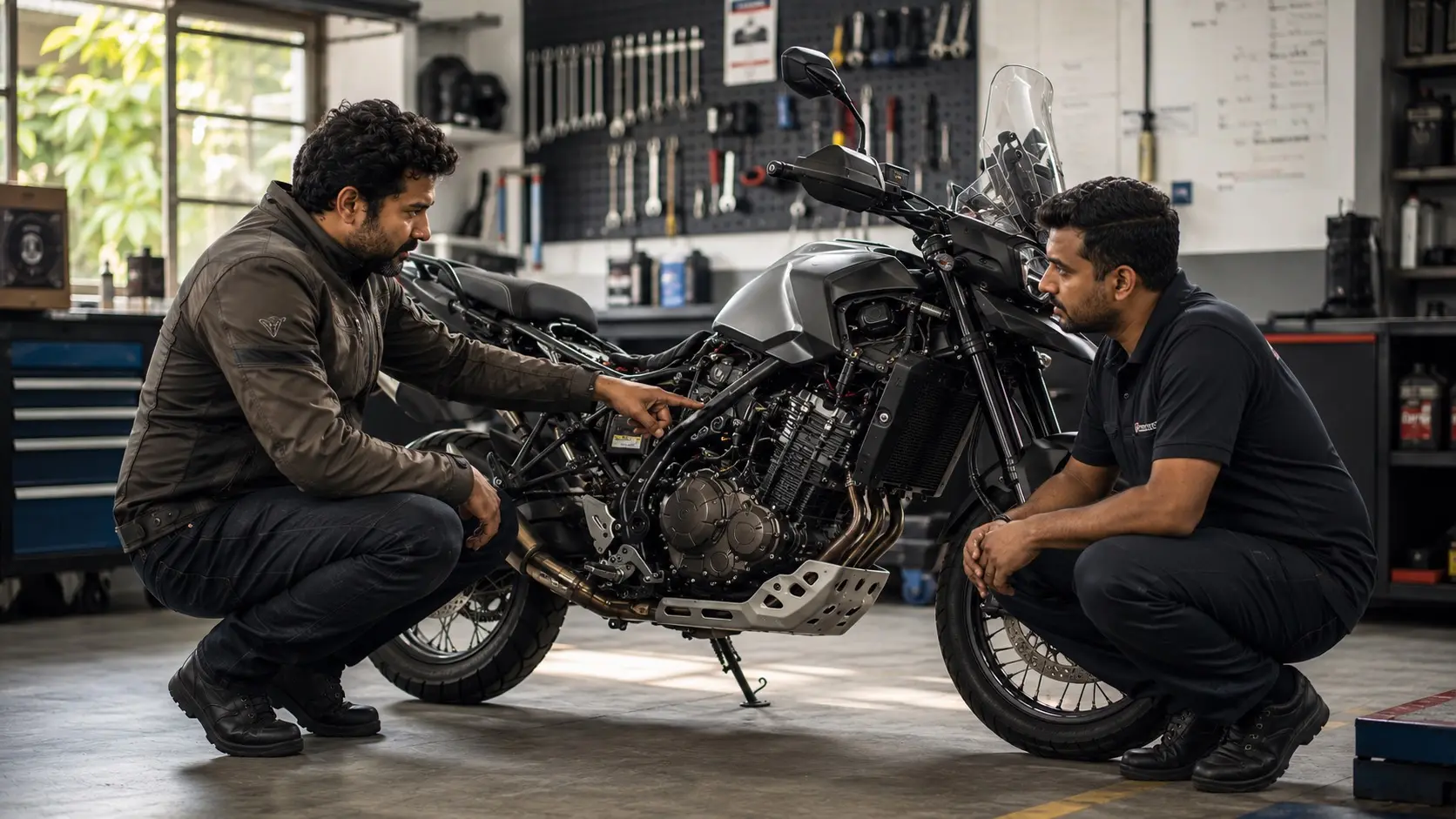
A Conversation Before A Repair
Eventually, every rider encounters something that sounds different.
Perhaps the engine seems slightly rougher.
Maybe a vibration feels unfamiliar.
Perhaps a small rattle appears where none existed before.
At that point, your greatest advantage is not mechanical expertise.
It is familiarity.
Instead of saying,
“My motorcycle sounds strange,”
you can explain,
“It has developed a light rattle during idle after warming up.”
That simple observation gives a technician a far better starting point than a vague description ever could.
Good mechanics appreciate riders who pay attention.
Not because they expect them to diagnose problems, but because careful observations often make diagnosis quicker and more accurate.
This is another reason listening matters.
It improves communication as much as it improves ownership.
Final Thoughts
Owning a motorcycle is not just about riding it.
It is about gradually getting to know it.
Every commute, every weekend ride and every long journey quietly teaches you something about the machine beneath you.
Over time, your motorcycle develops a familiar rhythm that no service manual can fully describe.
Learning that rhythm will not prevent every mechanical problem, nor will it replace professional servicing.
What it does provide is something every confident owner relies upon.
A sense of what is normal.
Because before you can recognise that something has changed, you first need to know your motorcycle well enough to recognise its voice.