Choosing Auxiliary Lights for Motorcycle Touring
Learn when motorcycle auxiliary lights are worth buying and how to evaluate beam patterns compatibility and installation.
A recommendation to fit more powerful auxiliary lights can sound like sensible touring preparation. But before buying them, it is worth asking whether the original headlight is actually limiting the riding you do.
For one rider, the answer may be no. If long rides are planned for daylight and the original headlight is sufficient for regular city commuting, additional lighting may offer little practical benefit. Keeping the motorcycle unchanged is a reasonable decision.
For another rider, regular travel on unlit roads may reveal a genuine need for better illumination. The purchase then becomes less about adding the brightest lights available and more about choosing a suitable, compatible, and responsibly installed lighting system.
Start with the riding you actually do
The first question is not how powerful the lights should be. It is what problem they need to solve.
A rider who occasionally returns home after sunset may not need the same equipment as someone who regularly travels on poorly lit highways. A touring rider who deliberately avoids night riding may have no reason to add auxiliary lights at all.
Before considering a purchase, establish whether the existing headlight is functioning correctly and whether its adjustment is appropriate. If the original lighting meets your needs, there is no obligation to replace it or add more equipment.
If you do identify a limitation, describe it as specifically as possible. Is the concern the distance illuminated ahead, the width of the beam, or visibility in particular conditions? That distinction will make the comparison between lighting options more useful.
More brightness is not always more useful
Auxiliary lights are often advertised through wattage and lumen figures. Those numbers can be useful, but they do not describe the complete lighting experience.
Wattage describes electrical power consumption. Lumens describe light output. Neither figure alone tells you how effectively that light is distributed on the road.
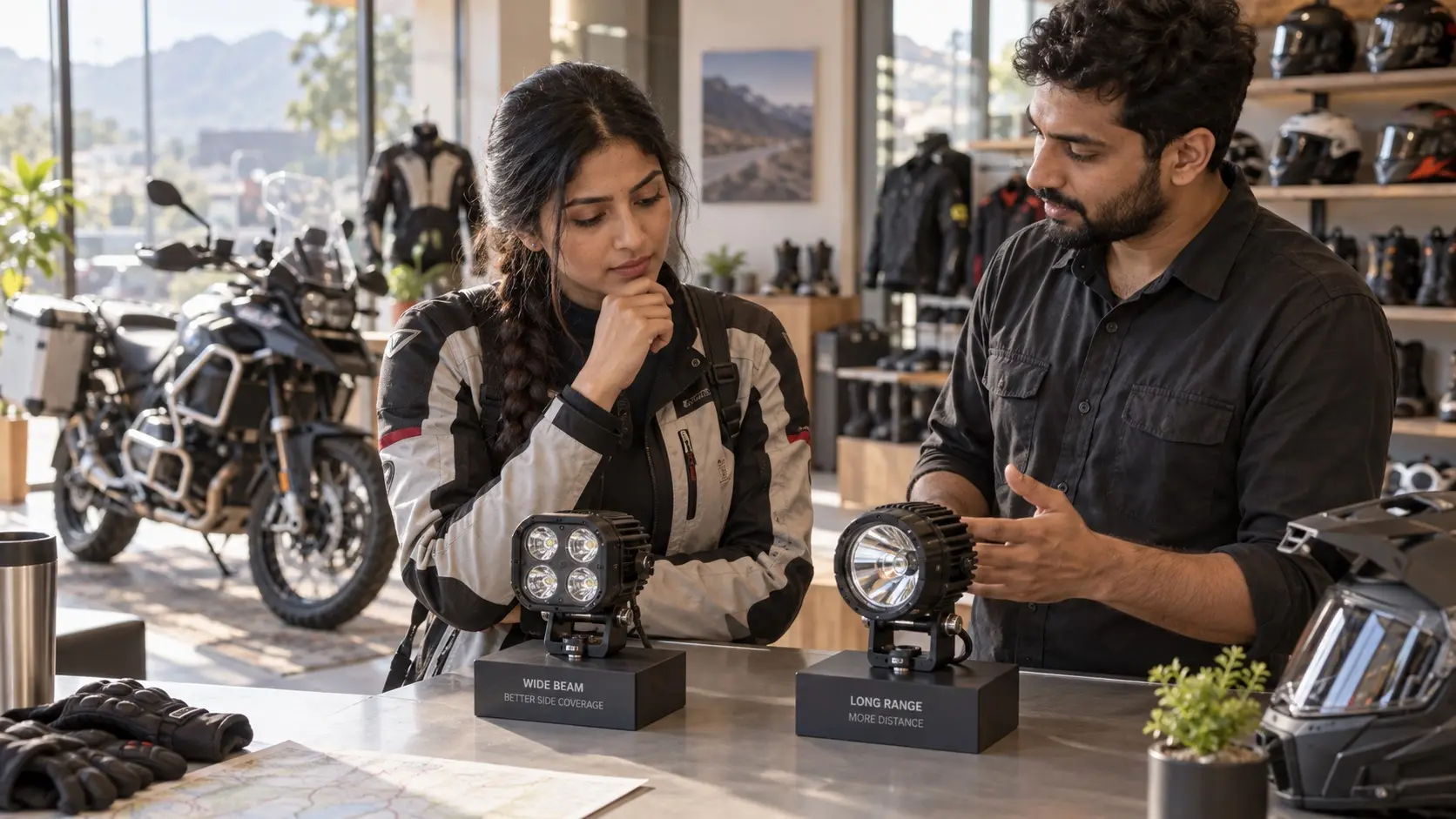
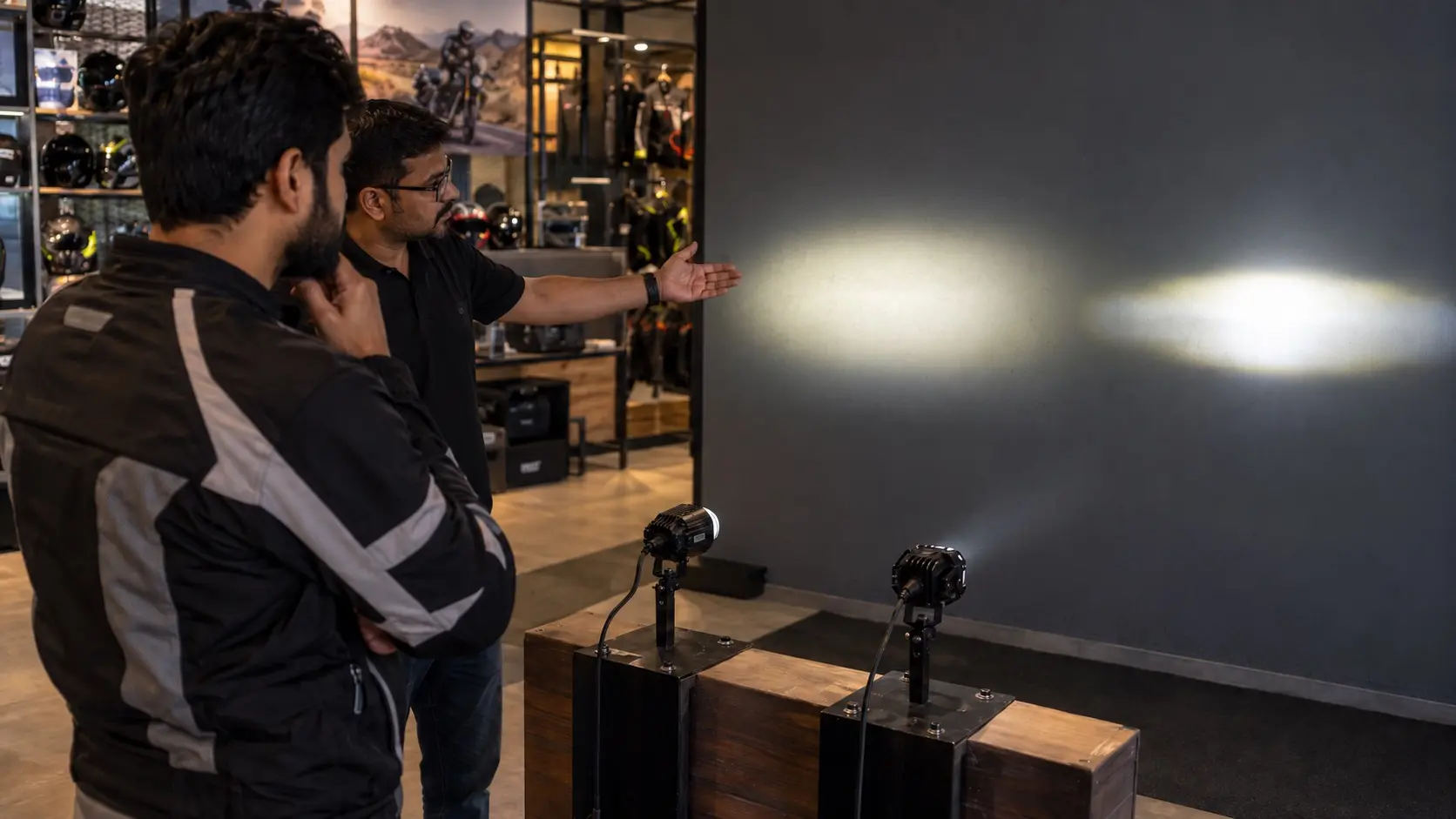
Beam pattern matters because different lighting designs serve different purposes. A longer-range driving beam may be intended to illuminate farther ahead, while a wider beam may provide more illumination closer to the motorcycle. Some systems combine different beam characteristics.
The appropriate choice depends on the intended use and the way the light is controlled. A powerful beam that creates excessive glare for other road users is not a better road-lighting solution simply because it appears brighter.
When comparing products, look for meaningful information about beam distribution, intended use, and how the lights are designed to operate. Avoid treating impressive brightness claims as a substitute for understanding the actual lighting pattern.
Consider the complete lighting system
Buying auxiliary lights is not necessarily the same as buying a complete installation.
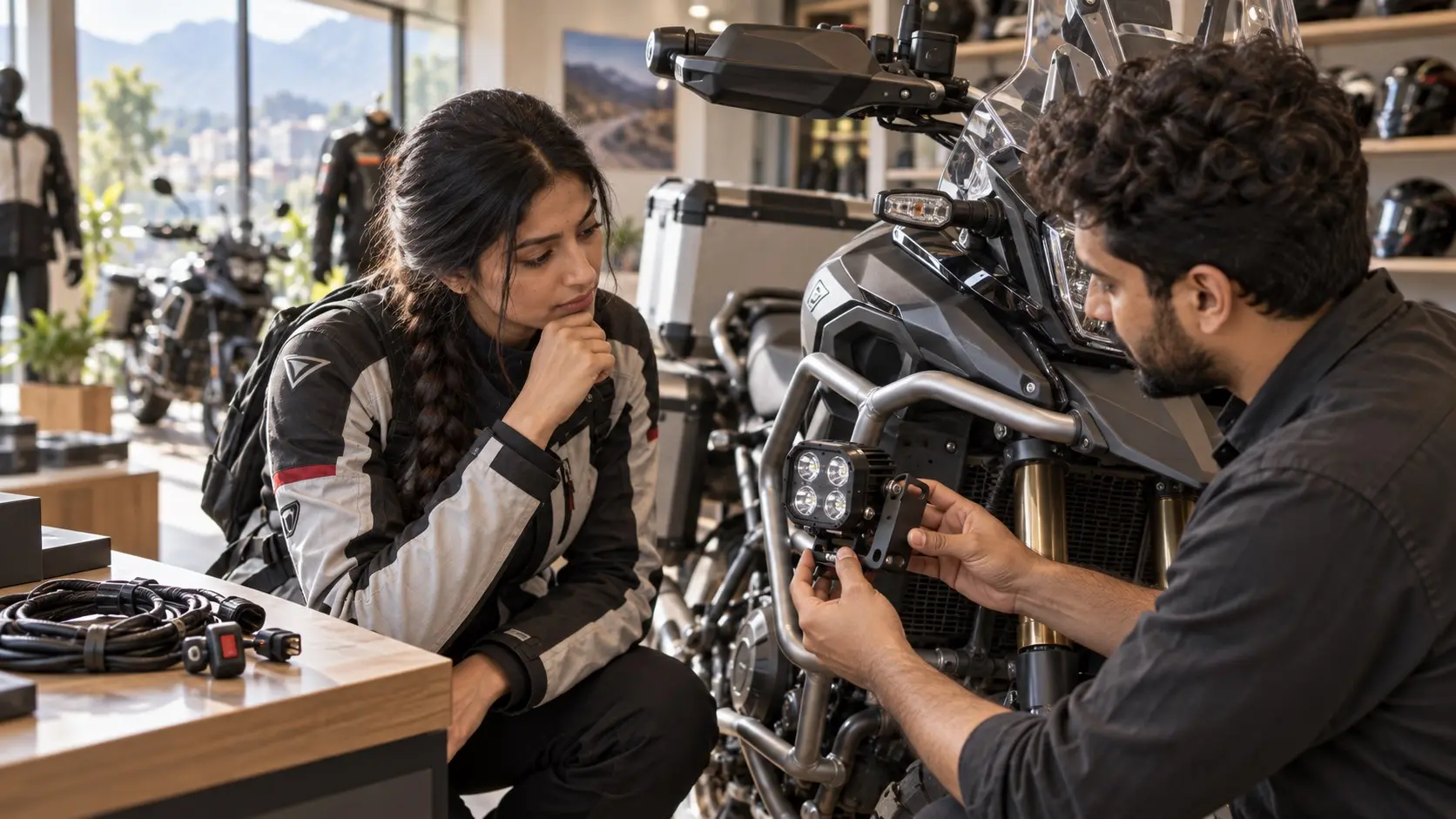
The lamps may require compatible mounting brackets, wiring, switches, connectors, and other electrical components. Some kits include these items, while others require separate purchases.
Before choosing a system, establish whether it is suitable for the motorcycle’s electrical system and whether the mounting arrangement is appropriate for the exact model. A kit described as universal should not be assumed to fit every motorcycle equally well.
The installation should also preserve the motorcycle’s normal operation. Wiring should be properly protected, electrical connections should be suitable for the environment, and the lights should not interfere with steering, suspension movement, or other components.
For a Royal Enfield Himalayan, for example, the sensible starting point is the documentation for the exact model and year rather than assuming that every accessory advertised for adventure motorcycles is compatible.
A qualified installer can help establish what the complete setup requires before you commit to buying it.
Think about everyday ownership
Auxiliary lights may be purchased for touring, but they remain part of the motorcycle between trips.
Consider how the mounting brackets, wiring, and switches will integrate with the bike. If you prefer a clean motorcycle without unnecessary permanent additions, that is a legitimate factor in the decision.
A compact, well-integrated setup may be more appealing than a larger arrangement that provides capabilities you rarely use. Conversely, a rider who regularly travels in conditions where additional lighting is useful may consider the extra hardware worthwhile.
The important point is to evaluate the complete system rather than the appearance of the lamps alone.
Responsible road use matters
Additional lighting should improve the rider’s ability to see without creating unnecessary problems for other road users.
Beam direction, mounting position, and the way auxiliary lights are switched or dimmed all deserve attention. A lighting setup intended for use on an empty, unlit road may not be appropriate for use around oncoming traffic.
Indian vehicle lighting requirements also need to be considered before purchase and installation. The Central Motor Vehicles Rules, 1989 include requirements concerning vehicle lamps and the prevention of dazzling beams. These requirements should not be reduced to a blanket assumption that every auxiliary light is either permitted or prohibited.
Before fitting a particular system, confirm the applicable current requirements for your motorcycle and intended road use with the relevant authority or a qualified professional. Do not rely solely on a seller’s claim that a product is road legal.
Price versus long-term value
The cheapest pair of lamps may not represent the cheapest complete installation. Equally, an expensive system is not automatically the right choice.
Compare the total cost of the lamps, mounting hardware, electrical components, and professional installation where required. Consider the quality of the construction, the suitability of the beam, the availability of replacement parts, and the support offered by the supplier.
For a rider who rarely needs additional lighting, the best value may be to retain the original headlight. For someone who regularly rides on unlit roads, a properly selected and installed system may justify the additional expense.
Value comes from solving a real problem, not from adding the largest number of features.
Final Thoughts
Auxiliary lights are not an essential upgrade for every touring motorcycle.
If your original headlight meets your needs and you avoid night riding on long trips, there may be no reason to add them. If your riding regularly exposes a genuine limitation, it is worth investigating a suitable lighting solution.
Begin with the problem, understand the beam characteristics, confirm compatibility, and consider the complete installation and its effect on everyday ownership.
The right decision may be to fit additional lights. It may also be to leave the motorcycle exactly as it is.